Pump canopy & islands
Look beyond the area directly under each light. Dispensers, canopy columns, vehicles, and mounting height affect coverage around pump islands and the paths customers take between them.
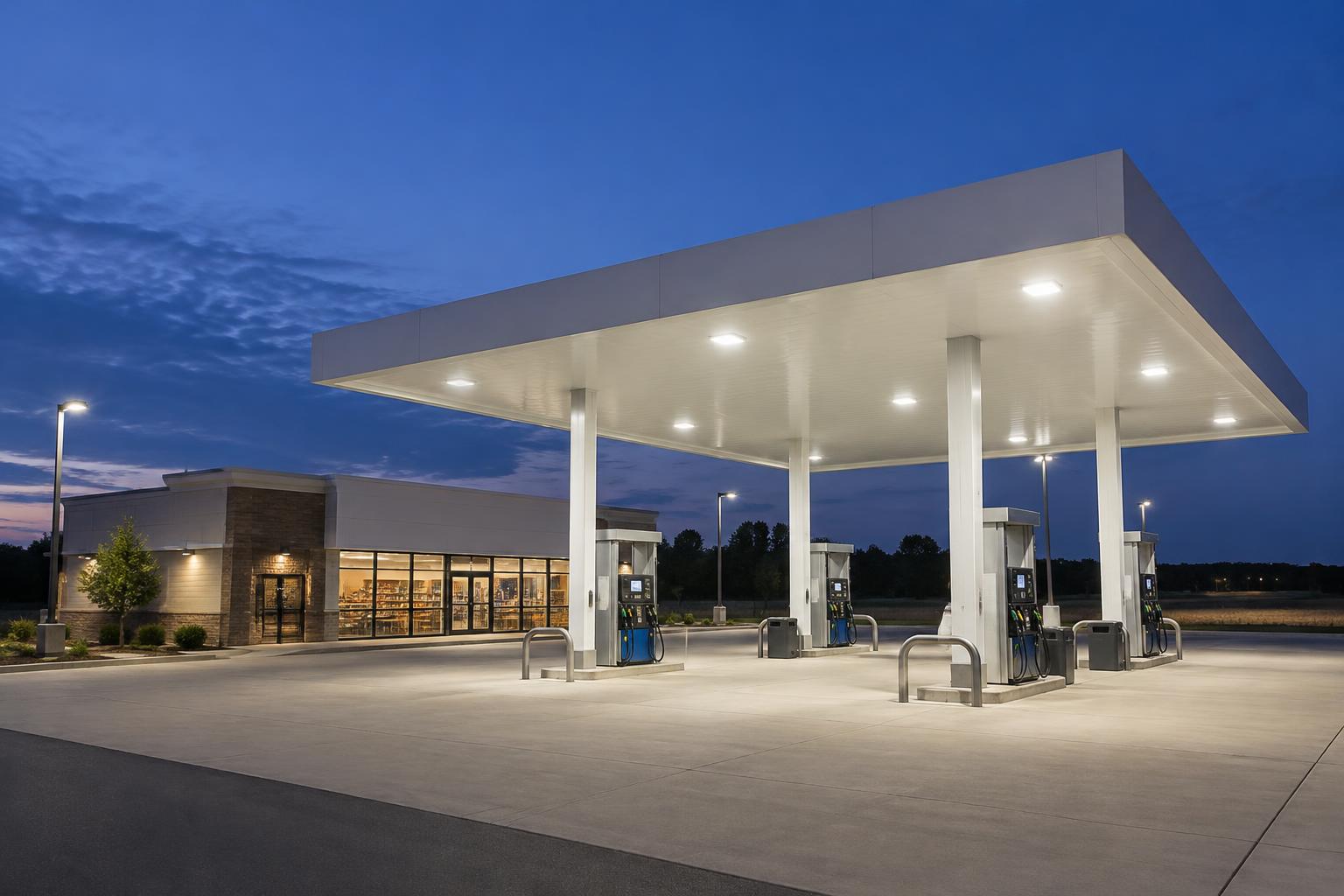
Bring canopy, forecourt, and convenience-store lighting into one site-specific plan. Edge LED Lighting helps Indianapolis gas station operators assess aging fixtures, select commercial LED options, and coordinate the work with our in-house installation team.
One property. Different lighting needs.
A canopy retrofit is not simply a smaller parking-lot project. Low-mounted fixtures above pump islands need different coverage from lights on tall poles. We consider the fueling area, store approach, and surrounding lot together while selecting fixtures for each setting.
Look beyond the area directly under each light. Dispensers, canopy columns, vehicles, and mounting height affect coverage around pump islands and the paths customers take between them.
Pole-mounted area lights serve drive aisles, parking spaces, and the transitions beyond the canopy. Their distribution should complement canopy lighting without pushing unnecessary light toward roads or neighbors.
Wall packs, entrance lighting, and shop lighting connect the fueling area to the store. Consider visual comfort, merchandise visibility, and the change in brightness as customers move indoors.
Older metal-halide or other HID canopy fixtures may be candidates for a compatible retrofit or a complete LED replacement. Existing housing condition, opening size, supply voltage, heat management, and product installation requirements help determine the approach, not simply the old lamp's wattage.
Recessed and surface-mounted arrangements need different mounting details. We review canopy height, available clearance, underside construction, and any adapters with fixture output, optical distribution, color temperature, outdoor suitability, and control compatibility. The goal is a suitable fixture for the canopy and the activity below it.
Explore LED canopy lightsForecourt and parking-area pole lights cover vehicle circulation, spaces beside the store, and areas outside the canopy footprint. Pole height, arm configuration, fixture orientation, and optical distribution influence where the light lands. Existing poles, mounting adapters, and electrical conditions need their own review.
Wall packs can support building-side paths, service doors, and store approaches. Consider suitable cutoff or shielding options and the interaction with pole lighting, rather than adding brightness to every wall. Nearby roads, homes, and property lines are part of the exterior plan.
Explore general parking lot lighting View wall pack fixture options Building exterior lighting for the storeInside the shop, ceiling layout, checkout tasks, product displays, and glare shape fixture selection. Consistent color appearance can matter when comparing the sales floor with entrance and canopy lighting.
If cooler or display lighting is part of your project, identify the equipment first. Cold-temperature suitability, moisture exposure, drivers, mounting, and manufacturer requirements need review. Specialized refrigerated-case lighting should be discussed as a separate compatibility question, not assumed to work with a general interior fixture.
See our commercial lighting services Go to the Request a Quote pageWhere appropriate, a photometric layout uses manufacturer IES files and site geometry to estimate illuminance across pump islands, circulation areas, and the store approach. Canopy mounting heights, columns, fixture spacing, and pole locations inform the model.
Average brightness alone can hide gaps. Reviewing minimum levels and uniformity helps compare layouts, while glare, the view from approaching vehicles, and property-line spill deserve separate attention. Fixture optics, orientation, and suitable shielding may help direct light where it is needed.
Planning targets depend on site use and applicable requirements. Modeled coverage is an estimate, not a guarantee of measured results or compliance; actual installation and site conditions matter.
Learn about IES-based lighting planningFuel deliveries, customer traffic, and lift movement make access planning important. We discuss work zones, equipment placement, operating hours, and potential phasing with your site contact before scheduling. Some pumps, parking spaces, or circuits may be affected.
Existing wiring and the proposed electrical scope require review. Equipment suitability, any applicable fuel-site requirements, and additional electrical needs should be resolved as part of planning. A lighting replacement should not be assumed to cover every electrical condition at the property.
Potential incentives depend on the utility serving your location, current program rules, selected products, and project details. Some programs require preapproval or specific documentation. We can discuss those questions alongside fixture options without assuming your project will receive a rebate.
Existing photocells, schedules, and compatible controls may also affect the scope. Review operating patterns and fixture compatibility rather than assuming one control strategy suits the canopy, parking area, and store.
From site details to installation
Tell us your location, operating hours, lighting concerns, and which areas need attention. Photos, canopy dimensions, and fixture details help define the starting point.
Assess mounting, existing equipment, access, and suitable LED options. Consider an IES-based layout when coverage or fixture placement needs closer review.
Review fixture selection, quantities, installation scope, and coordination needs. Discuss potential utility incentives and any requirements before proceeding.
Our in-house installation team coordinates with your site contact around agreed access and work areas. Confirm any affected pumps, parking spaces, or electrical interruptions.
Based in Indianapolis, Edge LED Lighting serves Indianapolis and Central Indiana and accepts commercial project inquiries nationwide, subject to scope, logistics and applicable local requirements. Share your station's address and the areas you want to upgrade so we can discuss project availability and site needs.
View our service areasBefore planning your upgrade
Possibly. Opening dimensions, canopy construction, fixture depth, mounting support, and the proposed product's installation requirements need review. A suitable mounting plate or adapter may be an option, but existing openings do not make every LED fixture compatible. Photos and measurements help us assess retrofit versus replacement options.
Fixture count depends on canopy dimensions and height, pump-island spacing, columns, the chosen fixture's distribution, and the areas being evaluated. Matching the old count or comparing wattage alone may miss gaps in coverage. A layout can help compare proposed counts and placement where appropriate.
Fixture type and quantity, opening adaptations, mounting heights, lift access, existing wiring and controls, and any additional electrical scope affect the proposal. Scheduling restrictions and phased work areas also matter. Share site photos, current fixture information, and operating requirements so we can discuss a site-specific quote rather than a generic per-light price.
That depends on the scope and site conditions. We discuss customer traffic, fuel deliveries, lift placement, work zones, and any affected electrical circuits with your site contact. Phased work may be possible, but pumps or sections of the forecourt may need temporary restrictions. The installation plan should identify those needs; uninterrupted operation is not guaranteed.
A layout is useful when changing fixture spacing, comparing canopy options, or addressing uneven coverage and spill light. It uses manufacturer IES files, mounting heights, and site geometry to estimate light distribution. Canopy and forecourt areas can be evaluated together. Not every retrofit needs the same level of modeling, and modeled results are not guaranteed field measurements.
Some projects may qualify for utility incentives, depending on the utility, current program, fixture eligibility, and installation details. Preapproval, product documentation, or other requirements may apply before work starts. We can discuss potential eligibility as part of your options, but neither approval nor an incentive amount is guaranteed.
Tell us about your location
Share your station's address, current lighting concerns, and whether the project involves the canopy, forecourt, store, or several areas. Include fixture counts, mounting heights, and operating-hour restrictions if you have them.
You do not need a finished lighting plan to begin. We can discuss the information needed to develop suitable fixture and installation options. Requesting a quote is free and carries no obligation.
(317) 548-5355